
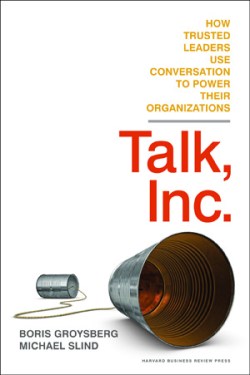
’Tis the season of year-end round-ups—a time when people look back and collect their thoughts on the “best” works to appear over the preceding twelve months.And we’re happy to report that a couple of outlets have included Talk, Inc., on their lists of notable business books published in 2012.

The Web site 800-CEO-READ, a retailer and information clearinghouse that has become a key player in the fast-changing business-book market, put our book on its shortlist of titles in the “Leadership” category.
Strategy + Business, a magazine published by the consulting firm Booz & Company, placed Talk, Inc., on its “Best Business Books 2012” list. (Free registration required. Visitors can also download a PDF of the magazine’s entire package of articles on the best books of the year.)

The editors of Strategy + Business cite our book under the rubric of “Organizational Culture.”In a piece that covers books in that category, writer Sally Helgesen offers this summary comment:
Talk, Inc. makes a powerful case that effective talk is the primary means of motivating and inspiring loyalty among today’s increasingly social and connected workforce. . . . Talk in all its manifestations—intimate, interactive, inclusive, and intentional—is the cultural instrument required to get people engaged.
Meanwhile, consultant Karina Butera recently posted a review of Talk, Inc., at her Web site. Here, in brief, is her verdict:
Overall, the authors give a compelling case for broadening the function of Corporate Communication from a one-way, top-down approach, to a two-way exchange. Talk, Inc. is well suited to executives wanting to gain better employee and stakeholder engagement and is a must-read for anyone specialising in Corporate Communications.
As strong business relationships are built from productive conversations, I see this book as an excellent guide to assist you in your business relationship building.
 Bob served up a host of great questions, and we did our best to provide thoughtful answers that didn’t merely repeat material that’s in the book. The result is a wide-ranging discussion that touches on our personal backgrounds, our speculations about the future of leadership, and our musings on how the likes of Lao-Tzu and Voltaire might provide insight into the meaning of organizational conversation.
 Religious leaders need to build a reliable, conversation-based rapport with their followers—just as business leaders do (if not more so). That’s why an editor at
  At the site, she offers good


 Talk, Inc.